What future would you have liked to be involved in, and if so, with whom?
19. November 2026
From making friends in the Metaverse to reclaiming the future – together
At a time of political uncertainty, economic disruption and accelerating technological change, the sixth edition of IMMERSIVE X invited an international community to do something unusually ambitious: reclaim its capacity to imagine and shape a future worth living in. For Brands & Places, part of this journey since the beginning, it also reaffirmed a conviction that has guided our work for years: meaningful transformation starts with people, and with the conditions we create for them to act together.
At the very first IMMERSIVE X in November 2020 we asked a deceptively simple question: How to make friends in the Metaverse? It was the middle of a pandemic that had fundamentally disrupted how we worked, learned and connected. Mark Zuckerberg had just presented his vision of the Metaverse, the technology industry was promising entirely new worlds, and everybody seemed to be talking about the next frontier of digital interaction. But for us at Brands & Places, something far more fundamental was at stake: What makes a digital space a place where people actually want to spend time, develop trust, build communities and create something together?
Together with Colleen Curtis, then Head of Community at Miro, and Manouchehr Shamsrizi of gamelab.berlin, our founder Anne Seubert explored the ingredients of community, connection and co-creation in a panel discussion. One of the most memorable examples came from Minecraft, where young people were building their own utopias and dystopias, making visible hopes and anxieties that might otherwise have remained unheard. What fascinated us wasn’t the technology itself, but the opportunities it created for people to express themselves, engage with different perspectives and become active participants rather than passive consumers.
„I feel like we have a responsibility – and I certainly do have an urge! – to architect healthy spaces for communities to challenge and if necessary transform our status quo!“
Anne Seubert, Co-Founder of Immersive X and CEO of Brands & Places
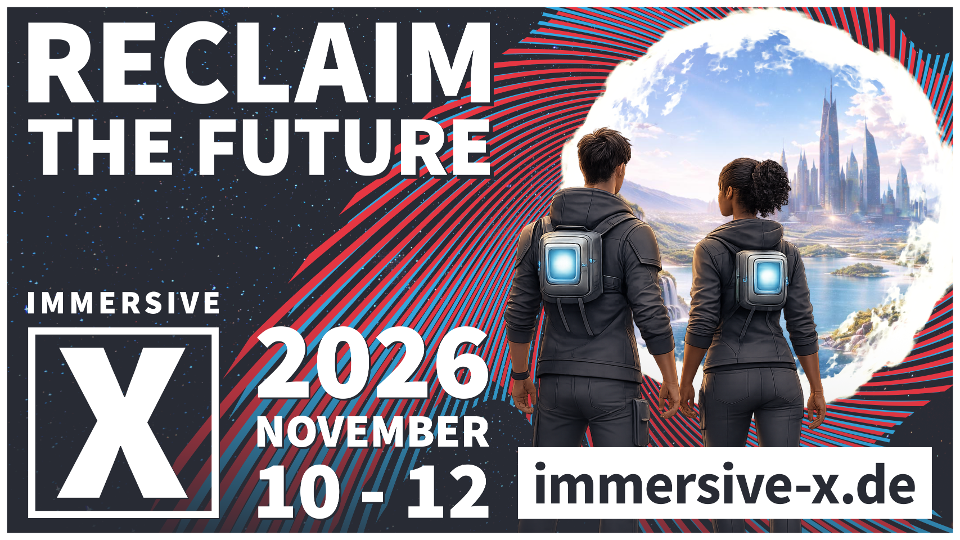
Five years later, the urgency behind those words has only grown. At IMMERSIVE X 2026, held under the motto RECLAIM THE FUTURE, the question was no longer how we connect in virtual environments. It was how we can use those connections to reclaim our confidence, our agency and our collective ability to shape what comes next: The Future, starting right now in the presence
People who continue to build, create, and push forward
There is a strange contradiction at the heart of our times. Never before have we possessed so many technological capabilities to transform the world, yet confidence in our ability to shape a desirable future appears increasingly fragile. Geopolitical conflict, economic uncertainty, climate change, social polarisation and the enormous speed of AI development are challenging established structures across society and business. The XR industry is no stranger to these dynamics. Years of inflated expectations, changing investment priorities and disappearing platforms have left many questioning the Metaverse’s commercial prospects. But while technology markets fluctuate, the international community around immersive experiences continues to experiment, exchange knowledge, support one another and build:
„the determination, optimism, and generosity of the people who continue to build, create, and push our medium forward.“
Thomas Zorbach, founder and curator of IMMERSIVE X and CEO of vm-people
There is a powerful lesson in that observation. Progress is not simply a function of investment, infrastructure or technological capability. It depends on the relationships, shared knowledge and mutual commitment that allow people to keep moving forward, particularly when circumstances become difficult. In preparation for the sixth edition, the IMMERSIVE X community was actively involved in shaping the programme. A community workshop in March influenced the decision to give collaborative workshops, cross-disciplinary conversations and topics such as power, governance and leadership more room than ever before. Thus it was not just an event created for a community, but increasingly an event shaped with it.
A bridge into 2056 — Where community becomes a force for social and economic change
The opening warm-up, developed by Thomas Zorbach and Anne Seubert together with artists SHUSHU VR and Niko Lang, translated the festival’s ambition into an experiential concept. Rather than beginning with a conventional welcome, participants were invited to enter an imagined future, thirty years from now. For n immersive yet participatory dramaturgy a luminous bridge led from the uncertainties of 2026 into a reimagined AREA X in the year 2056. The script even included an inquisitive little parrot welcoming visitors to their future surroundings. But behind the playful details was a serious exercise in changing perspective: What if, instead of asking what the future might bring, we started imagining what we would be proud to have made possible?
The heart of the concept was a series of conversations between participants, interviewing one another as their future selves. What had they accomplished? Which decisions had changed their lives? Which people, collaborations or unexpected encounters had made the difference? The exercise culminated in the creation of an imaginary autobiography, represented by a title and a personalized book cover, contributing to a collective Atlas of the Reclaimed Futures. This approach touches on something fundamental to our understanding of transformation at Brands & Places. Imagination is not merely an individual creative capacity. It becomes genuinely powerful when we share our visions, challenge one another’s assumptions and begin to recognize what we can achieve together. The Atlas was conceived to make that interconnectedness visible: many different life stories and futures, each shaped by individual agency but never created in isolation.
The relevance of this approach extended well beyond the festival’s opening. Across the programme, creators, researchers, entrepreneurs, educators and changemakers explored challenges in healthcare, cultural heritage, governance, business and society. Several contributions developed and moderated by Anne Seubert demonstrated how immersive spaces can support forms of engagement that are difficult to achieve through conventional communication.
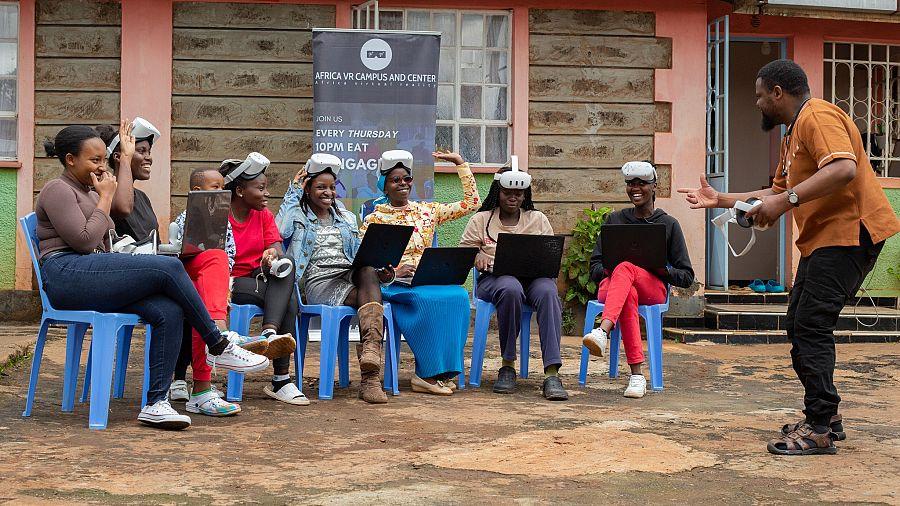
In Living Heritage — Reclaiming Cultural Memory Through Immersive Experiences, Marta Minguell Colomé, Danelson Maldonado González and Paul Simon Waiyaki brought perspectives from Europe, the Caribbean and Africa to a fundamental question: Who has the power to preserve, interpret and transmit cultural memory? One particularly inspiring example came from Africa VR Campus and Center. The initiative has been introducing artists in rural Kenya to virtual reality and photogrammetry, creating opportunities to bring their work into digital exhibition spaces. Its XR Girls Africa programme has likewise enabled young women to develop immersive technology skills in virtual learning environments.
„Tech is for eVRyone.“
Paul Simon Wakaiyaki, Founder and CEO of the Africa VR Campus and Center
It may sound simple, but its implications are profound. When technology becomes a means of giving underrepresented communities access to skills, visibility, networks and potential markets, the debate moves far beyond technological novelty. It becomes a question of cultural participation, economic opportunity and who gets to shape emerging digital economies. Another contribution approached societal transformation from a very different direction. In The Choices We Think We Make, Anne joined Helen Lundström Erwin, founder of the virtual Foremothers Café, to explore how history, social expectations and systems of power influence our decisions. The workshop concept invited participants to examine the conditions that shape political choices, reproductive autonomy, solidarity and our willingness to act for the long-term future. The guiding question was as provocative as it was moving: What conditions do we need to create so that we can become the foremothers our future needs? The question goes right to the heart of contemporary leadership and social responsibility. We cannot ask people to make better choices without examining the systems, incentives and relationships that enable or prevent those choices.
The same principle applies to healthcare innovation. In Who Wants to Be a Healthenair?, an interactive format developed with Ines Heitkamp of MedTriX Group and D.J. Smith of Glimpse Learning, the audience was invited to explore the intersection of AI, immersive technology and healthcare through a quiz show. The underlying question was anything but trivial: How can emerging technologies make knowledge more accessible, medical education more engaging and new healthcare solutions more inclusive?
Across these very different fields, a consistent theme emerged from the programme’s design: Technology can create access and possibility, but people, participation and purposeful collaboration determine the value it ultimately delivers.
Take Away: Community is not a marketing tool, it is a transformation infrastructure.
For companies, institutions and policymakers, this is perhaps the most important lesson to take from IMMERSIVE X. We have become remarkably good at measuring technological progress through investment volumes, adoption rates, efficiency gains and commercial growth. Yet many of the capacities essential to navigating uncertainty are much harder to quantify: trust, knowledge-sharing, psychological safety, openness to different perspectives and leadership as the ability to coordinate action across organisational and disciplinary boundaries. These capacities do not emerge automatically when we assemble people in the same room, whether physical or virtual. They require thoughtful design, shared purpose, skilled facilitation and continuous investment in relationships. Communities are not audiences to be activated when a new product is launched. They are living ecosystems in which people contribute knowledge, challenge one another, develop capabilities and create value that extends beyond any individual participant.
For organisations facing complex transformation, this is not a soft consideration. It is a strategic necessity. The challenges shaping our economies and societies increasingly exceed the capacity of any single organisation or discipline to solve them alone. Innovation depends on the ability to connect knowledge and capabilities that have traditionally remained separated. That is why we believe community building should be understood as a form of economic and social infrastructure. It strengthens an ecosystem’s capacity to learn, adapt, innovate and act when established approaches are no longer sufficient.
Since the first IMMERSIVE X in 2021, Anne Seubert and Brands & Places have been engaged in this journey alongside the spiritus rectusThomas Zorbach and the growing international festival community. What began with curating the community track and exploring the foundations of connection and co-creation has developed into an ongoing collaboration encompassing strategic sparring, connecting people and ideas, designing participatory formats and moderating conversations across sectors.
For IMMERSIVE X 2026, our involvement included co-developing the opening experience and contributing to sessions at the intersection of cultural heritage, social responsibility and healthcare innovation. Although the topics were different, they were connected by the same underlying concern: How can we create the conditions for people to participate meaningfully in shaping their own lives, organisations and societies? We don’t see the role of a facilitator, curator or ecosystem developer as simply bringing interesting people into a room. Our work is to help create the trust, shared direction, productive friction and structures of collaboration that allow something meaningful to grow from their encounter.
The future is ours to reclaim — together
IMMERSIVE X 2026 is a reminder that the most valuable resource in times of uncertainty may be neither a technological breakthrough nor a perfect prediction of what lies ahead. It may be our capacity to imagine alternatives together, to share knowledge and responsibility, and to turn collective ambition into collective action. For Brands & Places, this is both a conviction and an invitation. Whether we are working with companies, cultural institutions, healthcare organisations or cross-sector ecosystems, we believe that transformation begins when people stop seeing themselves as spectators of change and start recognizing their ability to influence it.
Thus the measure of success as not how many people attended a session, but what becomes possible because they met and the future is not something we inherit. It is something we create with one another. Perhaps the best place to start is with a simple question: In which future would you have liked to play a part, what role would you most have liked to take on, and—if so—alongside whom?